Store
Store
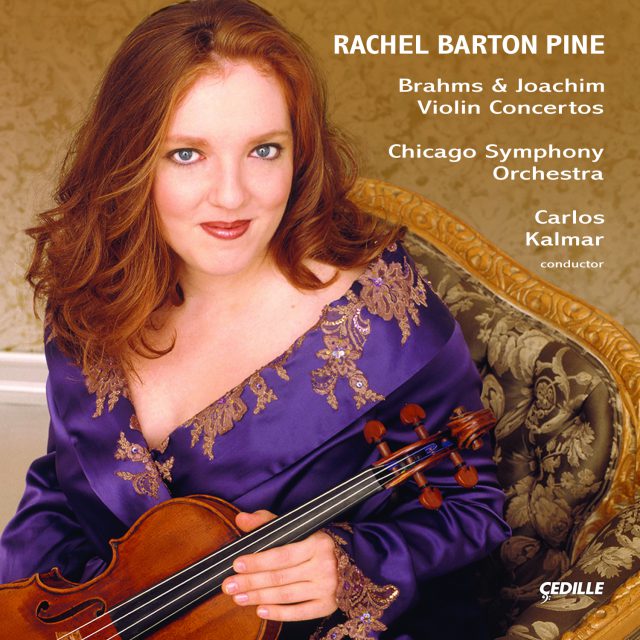
Brahms & Joachim Violin Concertos
Rachel Barton Pine, Chicago Symphony Orchestra, Carlos Kalmar
I have been fascinated with the Brahms Concerto since my earliest violin lessons. I began studying it when I was 14, and it rapidly became a mainstay of my repertoire. It was with the Brahms Concerto that I won several of my international prizes and made many of my debuts in Europe and America. It remains one of the most fulfilling works I perform.
I have been intrigued by Joachim’s “Hungarian” Concerto for many years. When I began to study it intensely it seemed a very natural fit, enhanced by two of my professors’ strong connections to this music. One of my Chicago teachers, Roland Vamos, shares Joachim’s Hungarian Jewish heritage. As a youngster, Dr. Vamos frequently accompanied his father to hear gypsy music in the cabarets of New York’s Hungarian section. He even supported himself through college by playing gypsy tunes as a strolling violinist. His stylistic knowledge was an invaluable resource. My teacher in Berlin, Werner Scholz, was a student of Gustav Havemann, who studied with Joachim. I feel fortunate to have gained knowledge about both the Joachim and Brahms Concertos from one so close to the original source. My study of the Brahms was augmented also by reading Joachim’s essay in his Violinschule in which he laid out how he felt the Brahms concerto should be played.
The long friendship between Brahms and Joachim enhanced their music and their lives. Friendship has also enhanced the performances on this recording. When I debuted with the Chicago Symphony at age ten, I gushed in a televised interview, “the Chicago Symphony isn’t just any old orchestra. It’s a great big, super-duper orchestra!” Over the eighteen years and many solo performances that followed, I came to know most members of the orchestra personally. The coaches, mentors, and teachers of my early teens have become chamber music partners, colleagues, and friends. Our history of working together adds a special dimension to the music whenever we collaborate.
I first met Maestro Carlos Kalmar shortly before this recording when we collaborated on the Joachim “Hungarian” Concerto in concerts with Chicago’s Grant Park Orchestra. He is an amazing and inspiring musician with a warm personality. I will always be grateful for his musicianship, humor, and energy throughout our two-day recording marathon. He became a kindred musical spirit and a dear friend. I am very excited to be able to share with you these two wonderful concertos.
Preview Excerpts
JOSEPH JOACHIM (1831–1907)
Violin Concerto No. 2 in D minor, Op. 11
Artists
Program Notes
Download Album BookletBrahms and Joachim Violin Concertos
Notes by Rachel Barton Pine
This is the first recording to pair the Brahms Violin Concerto with the “Hungarian” Concerto by Joachim, inviting a musical exploration of the close relationship between Joseph Joachim and Johannes Brahms. When they met in 1853, the twenty-one-year-old Joachim was already an established violin virtuoso and composer. The extremely gifted Brahms, two years younger, was virtually unknown. They quickly became close friends and began a musical interchange that lasted throughout their lives.
Brahms and Joachim challenged each other constantly, trading counterpoint exercises along with their correspondence. In 1853, they roomed together in Göttingen, and Brahms began to study orchestration with Joachim. Joachim served as a mentor to Brahms, introducing him to Schumann and other leading musicians of the day. Brahms, never generous with compliments, praised Joachim’s compositions consistently. Brahms wrote to his friend on February 16, 1855, “…nobody has wielded Beethoven’s pen so powerfully.… I wish you realized only the half of how much your works absorb me.…” In another letter he wrote, “there was more in Joachim than in all the other young composers put together.” Brahms considered Joachim more gifted than himself and always encouraged him – privately and publicly – to devote himself more fully to composing.
By 1854, Joachim had already made significant progress on his second violin concerto, Op. 11, “In the Hungarian Style.” It took him nearly six years to complete what became his most famous and important composition. He dedicated it to Brahms and gave its premiere in Hanover in 1860. Brahms conducted Joachim in several performances of the “Hungarian” Concerto and encouraged his friend to perform it frequently. Many contemporaneous critics considered it among the greatest works ever written for the violin. A concert review by Eduard Hanslick for Vienna’s Die Frei Presse on March 11, 1863 described the concerto as ” . . . a tone poem full of mind and spirit, of energy and tenderness that secures Joachim an extraordinary place among modern composers.” In 1894, The Strad pronounced it ” . . . one of the greatest masterpieces of violin music in existence.” And in the 20th century, famed violin pedagogue Carl Flesch (1873-1944) declared in his Memoirs that the “Hungarian” Concerto “marks a climax in our literature; it is the most outstanding creation that a violinist has ever written for his own instrument.”
The “Hungarian” Concerto marked a significant departure from other concertos of the day, which often emphasized technical display to the detriment of deeper musical content. Joachim frowned on elaborate pyrotechnical displays, believing that “music is the purest expression of feeling; only that which is superficial, unnatural, or self-conscious is foreign to it”.1 True to this belief, every note in the “Hungarian” Concerto serves a higher purpose. No passage, no matter how difficult, is inserted for the sake of show. The soloist is never allowed to triumph at the expense of his or her colleagues.
Nevertheless, Joachim managed to write what has been called the most difficult work in the repertoire. Renowned for his large hands and remarkable stamina, Joachim probably gave little thought to the difficulties presented by the massive chords that stretch and contort the left hand and challenge the bow arm to produce a full and sustained tone. Practicing the “Hungarian” Concerto is like training to run a marathon. Moreover, at over forty-seven minutes, the Concerto has been called “the longest example of perfect classical form.”2 Any attempt to cut passages (as some have done) unbalances the architecture and diminishes the piece significantly.
The first of the concerto’s three movements, Allegro un poco maestoso, is in sonata form with a double exposition and a coda that includes a lengthy cadenza. The first melody immediately evokes a Hungarian flavor. The massive opening tutti is modeled after that of Beethoven’s Piano Concerto No. 3 in C minor. Its extended, highly symphonic writing gives no indication that the work is a concerto. Following this, Joachim abandons completely the usual grand entrance of the soloist. Instead, the solo violin joins the other instruments, almost as a chamber-music partner. They pass melodies back and forth throughout the movement, with the soloist alternating between main voice and descant. The highly embellished style of many of Joachim’s melodies shows a familiarity with gypsy fiddlers. (Having left Hungary as a young boy, Joachim did not distinguish between the music of gypsies residing in Hungary and the folk music of ethnic Hungarians.)
Joachim deviates from tradition in the movement’s development section by re-arranging the order of his initial material and by adding an entirely new theme. This development section is particularly imaginative in its use of key changes and in the variety of orchestral colors displayed. The recapitulation follows the melodic course of the opening tutti rather than that of the first solo. A section of new material features the soloist playing a series of descending chromatic octaves that Joachim compared to the neighing of a horse. The cadenza begins with the unaccompanied soloist playing a contrapuntal improvisation on the opening theme. Eventually, a flute and an oboe each join in turn, helping to integrate the cadenza into the structure of the movement. Concluding the movement with a gesture similar to a passage in his cadenza to the Beethoven Concerto, Joachim again gives the soloist chromatic octaves – this time a descending scale spanning two-and-a-half octaves – which lead to the end of the coda.
The second movement (Romanze: Andante) is in truncated ABA form with a coda. “There is such charm and friendliness in it,” Brahms wrote in 1858. “The whole flows along so tranquilly and one part evolves from the other so beautifully that it is a joy.” While the endings of the first two phrases of the main theme are very characteristically Hungarian, both phrases begin not with the typically Hungarian “snap” of a sixteenth note followed by a dotted eighth, but with quarter notes preceded by grace notes. An agitated middle section contrasts dramatically with the more peaceful sections surrounding it. For the return to the A section, a single cello plays the entire first theme while the solo violinist performs elaborate embellishments. Here Joachim demonstrates his deep devotion to Bach with ornamentation that is organic, melodic, and harmonic – not merely decorative.
The Finale alla Zingara is a huge movement in rondo form with the following structural scheme: A-B-C-A-D-A-B-C-coda. Its opening horn call shatters the tranquil ending of the second movement. (Such horn calls are a recurring motif that unites all three movements.) The A section is in a perpetual motion style that makes use of the “gypsy scale” (harmonic minor with a raised fourth) and demands the utmost virtuosity from soloist and orchestra alike as they toss melodies back and forth. Other orchestral sections employ various dance rhythms and rampant “snaps,” while the soloist’s double-stopping is so intense that it sometimes feels as though Joachim has incorporated a whole band of fiddlers into a part written for one. A new theme introduced at the beginning of the coda has a triumphant feeling, and the concerto dashes to the finish line with a final burst of energy. This movement inspired Brahms to write his beloved Hungarian Dances (originally for piano, four hands), which Joachim later transcribed for violin and piano.
Despite their Hungarian flavor, Joachim’s melodies are entirely original; they incorporate no traditional tunes. Rather than lightening the effect of his concerto, they succeed in elevating the Hungarian style from its humble origins to grand nobility, infusing introspection as well as virility.
Throughout their friendship, Joachim was unwavering in his support of Brahms’s compositions. He performed Brahms’s chamber works, premiering many of them, and conducted Brahms’s symphonies. Joachim was particularly fond of the Brahms Violin Concerto. He described the work, which Brahms dedicated to him, as one of “high artistic value” that roused in him “a peculiarly strong feeling of interest.”3
Brahms began composing his Violin Concerto in the summer of 1878, during a vacation on Lake Wörther in Pörtschach, Carinthia (Austria). On August 22, Brahms sent the manuscript of the violin part to Joachim with this note: “Naturally I wish to ask you to correct it. I thought you ought to have no excuse – neither respect for the music being too good nor the pretext that orchestrating it would not merit the effort. Now I shall be satisfied if you say a word and perhaps write in several: difficult, awkward, impossible, etc.” Thus began one of the most intriguing musical exchanges in history.
By the time Joachim premiered the concerto in Leipzig on January 1, 1879, the piece had undergone considerable changes. Two middle movements had been removed and replaced by a newly written Adagio, resulting in the three-movement concerto we know today. (Both of the original middle movements are now lost. Many scholars think that the Scherzo may have been converted into the Allegro appassionato of the Second Piano Concerto.) The score was passed back and forth at least a half dozen times before the premiere, and the two friends’ debate over revisions, which is clearly evident in the surviving manuscript, has been left for posterity. In the end, Brahms incorporated most of Joachim’s suggested orchestral changes but considerably fewer of his revisions to the solo violin part.
The first movement of the Brahms Concerto follows the example of both Joachim and Beethoven in integrating the solo part with the orchestral writing. Often the solo violin plays counter-melody while other instruments play the main material. Brahms left the composition of the cadenza to the performer. Joachim wrote his own cadenza, which remains the one most frequently performed. There is some evidence that Brahms had a hand in its creation. Brahms wrote to Elizabet von Herzogenberg of an early performance, “the Cadenza sounded so beautiful at the actual concert that the public applauded it into the start of the Coda.”
The Brahms Concerto is often described as “masculine,” due in large part to its robust first movement. I am continually awed by the majestic and inexorable qualities of such sections as the opening solo and the broken octaves in the development. If the Beethoven Concerto captures the beauty of God’s creation, the Brahms Concerto conveys its magnitude and power.
Many in the first generation of violinists exposed to the concerto did not recognize its brilliance. Referring to the second movement, Spanish virtuoso Pablo de Sarasate complained that he had to stand on stage while the oboe played the only good melody in the whole piece. This comment illustrates the difference between the straightforward melodic concept of the Franco-Belgian virtuoso school and the more complex treatment employed by Brahms and his musical compatriots. Simple in structure, this movement contains some of the most profoundly beautiful music ever written for the violin.
Brahms drew inspiration for the third movement from the Finale of Joachim’s “Hungarian” Concerto. Here Brahms’s rhythmic vitality and melodic exuberance evoke the same mood as do other Hungarian-inspired works, but without relying on gypsy tunes or the gypsy scale. Unlike the headlong rush that concludes the Joachim Concerto, the poco piu presto at the end of the Brahms calls for a march-like, steady beat, and even implies a slight ritard in the final bars. Nonetheless, both concertos end with D-major chords that confer a feeling of genuine, well-earned triumph.
Despite the Brahms Violin Concerto’s decidedly mixed initial reception, it has become one of the most popular and beloved works in the violin repertoire. In contrast, Joachim’s “Hungarian” Concerto will be a real discovery for many modern listeners. I hope that awareness of the Joachim Concerto’s influence will shed new light on the Brahms Concerto and that Joachim’s masterpiece will one day reclaim the great appreciation it once enjoyed.
1 – letter to Woldemar Bargiel, April 7, 1853
2 – Frederic Emery, The Violin Concerto, 1928
3 – Joseph Joachim and Andreas Moser, Violinschule, 1902-05
About the Cadenzas
This recording includes two different cadenzas for the Brahms Concerto. When I repeat the Concerto in a series of concerts with the same orchestra, I often play a different cadenza each night, alternating my favorites – by Ysaye, Kreisler, and Maud Powell – with the one I composed. For a recording that emphasizes the relationship between Brahms and Joachim, it seemed appropriate to perform Joachim’s original cadenza in the context of the complete concerto. I felt, however, that my interpretation would be incomplete if I did not also include an organic reflection of my own ideas about Brahms’s composition.
Therefore, track 5 of the Brahms disc begins with my cadenza and continues with the orchestra to the end of the movement. To hear it in context, listen to the first movement up to the end of track 1, then immediately advance the disc to track 5. (You can do this manually if it is not possible to program your CD player in advance.) I hope you will enjoy the variety offered by these two different conclusions to Brahms’s first movement.
About the Violin
It was a special privilege to play the 1742 Joseph Guarneri “del Gesu” violin known as the “ex-Soldat” for this album because the instrument has an intimate connection to this repertoire.
In 1875, an extremely talented young musician named Marie Soldat (1863-1955) decided to give up the violin to develop her talents in piano and voice. Hearing Joseph Joachim perform in Graz three years later, however, inspired her to return to the violin, and to study with him.
Marie Soldat was introduced to Brahms at Pörtschach during a summer tour of Austrian spas in 1879. After hearing her play, he arranged a benefit performance to help pay for her studies. Brahms also gave her money for a train ticket to join him and Joachim in Salzburg. When she began to play the Mendelssohn Concerto with Brahms at the piano, the strings on her violin snapped. Joachim handed her his Stradivari, and her performance was so impressive that Joachim accepted her into his class at the Hochschule für Musik in Berlin.
Soldat (later Soldat-Röger) became a member of Brahms’s inner circle and a regular chamber music partner. Their friendship continued throughout his life. The famed pianist and conductor Hans von Bülow once introduced her as “Brahms’s understudy.”
Soldat was widely considered one of the greatest violinists of her day. She studied the Brahms Concerto with both Joachim and Brahms, and it became her signature piece. She introduced it to many European cities, including Vienna in 1885, with Hans Richter conducting the Vienna Philharmonic. She gave it its second performance in Berlin, with Joachim conducting.
Brahms selected this violin for Soldat in 1897 and arranged for a wealthy Viennese businessman to purchase it and loan it to her for her lifetime. The Strad, in 1910, remarked that “…[it] bears most of the characteristics we have learnt to associate with this maker in a remarkable degree. The tone is of extraordinary beauty, and suits the violinist’s virile style admirably.… The tone is full and rich, and noticeably deep on the G string. All the outlines of the fiddle seem to breathe life and strength.”
I like to think that Brahms chose this violin, in part, because its voice represents most closely what he envisioned for his concerto. I hope you enjoy hearing the sound of this amazing instrument as much as I enjoyed playing it.
Album Details
Total Time: 97:15
Recorded: July 2 & 3, 2002 in Orchestra Hall, Chicago
Producer: James Ginsburg
Engineers: Christopher Willis and Bill Maylone
Front Cover Photograph: Andrew Eccles
Graphic Design: Melanie Germond & Pete Goldlust
Notes: Rachel Barton Pine
Violin: “ex-Soldat” Guarneri del Gesu, Cremona, 1742.
This recording was made possible by a generous grant from the Sage Foundation
© 2003 Cedille Records/Cedille Chicago
CDR 90000 068